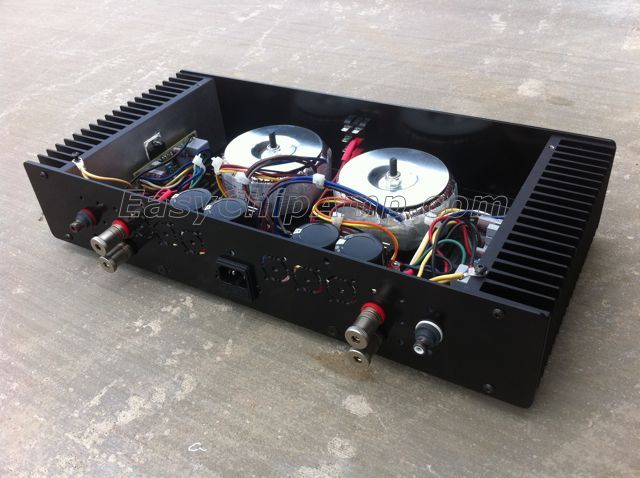
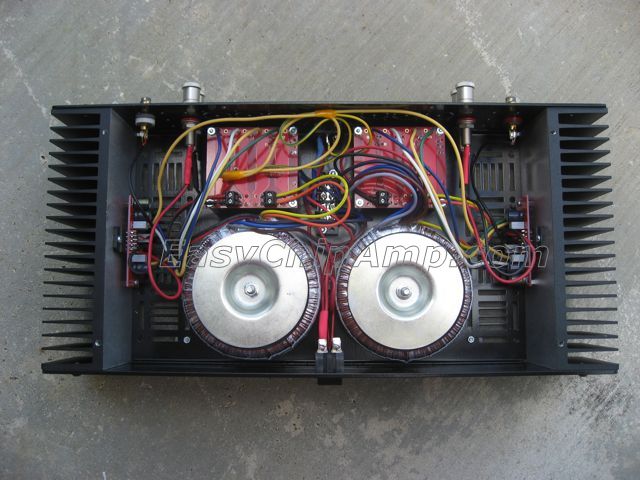
Unsatisfied with the sound of my gainclone amplifier (see an earlier post), I re-used the enclosure and the power supply for a gainclone along the lines suggested by Bob Cordell, whose implementation of an LM3886 based amp was praised by at least one member on the NJ audio society. Quote:"Bob showcased the Super GC at the NJ Audio Society and it sounded fantastic."
I skipped both the Klever Klipper and the toroidal air core output inductor, and kept only 10,000 uF per rail in the PSU. The schematic can be found in Chapter 27 of Cordell's Designing Audio Power Amplifiers. The PCB was designed to re-use the existing mounting holes of the ChipAmp's PCB.
The result? Better than with a plain vanilla chip amp, but IMHO still not good enough for music. Perhaps I should not have limited myself to re-use of the PSU et al. but should have taken all the details of my implementation seriously.
That was 2011. Looking back from 2019, I know I can do better! For more details, check out this discussion at diyAudio.com and my boards on sale.
I skipped both the Klever Klipper and the toroidal air core output inductor, and kept only 10,000 uF per rail in the PSU. The schematic can be found in Chapter 27 of Cordell's Designing Audio Power Amplifiers. The PCB was designed to re-use the existing mounting holes of the ChipAmp's PCB.
The result? Better than with a plain vanilla chip amp, but IMHO still not good enough for music. Perhaps I should not have limited myself to re-use of the PSU et al. but should have taken all the details of my implementation seriously.
That was 2011. Looking back from 2019, I know I can do better! For more details, check out this discussion at diyAudio.com and my boards on sale.